The Impact of Soj
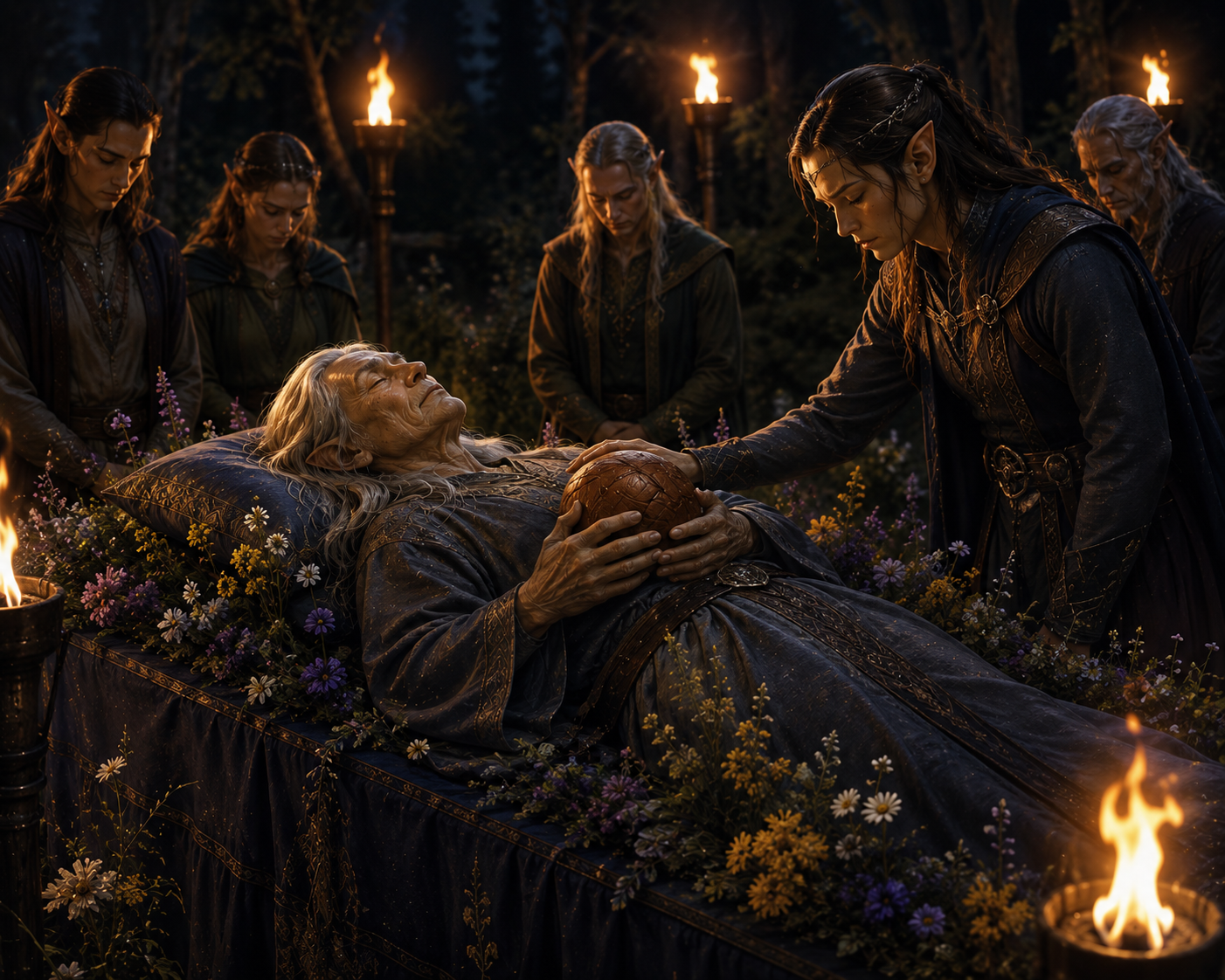
The night was quiet as family and lifelong friends stand together to honor the departed. The elder lay peacefully, hands folded across the chest.
Resting between those hands is an old polished wooden Soj. The grain has darkened with age. Its surface is worn smooth by decades of use.
One of the mourners stepped forward. They rest a hand gently upon the elder's shoulder. Their eyes linger on the Soj.
With the faintest smile, they whisper: "The last point is yours."
Soj
Soj is one of the oldest and most widely played games among elven children throughout Telan'Shaara. More than a game of speed or strength, it teaches awareness, patience, teamwork, control, and thoughtful decision-making. Elders often remark that the way a child plays Soj says much about the kind of adult they will become.
The game takes its name from the ball itself, also known as the Soj. The ball is roughly the size of a grapefruit, is made from highly polished wood that shows the grain, although it is also prone to showing the wear of the countless hands it has known.
A Soj pitch may be nearly any size, provided both teams agree before play begins. Unlike human sporting fields, elven pitches are rarely artificial. Trees, rock outcroppings, streams, roots, and changes in elevation are considered natural parts of the game, and both teams agree beforehand on what terrain is in play. The field is generally rounded and is divided into three areas: the defensive end, the center circle, and the offensive end.
At the center of the field lies the Center Circle. Only the two designated center players—one from each team—may enter this circle during play.
Each team consists of seven players: three offensive players, three defensive players, and one center player. Offensive players may never enter the defensive half of the field, and defenders may never cross into the offensive half. Roles remain fixed during play, although teams may substitute an offensive player for a defender during a stoppage in play. Such substitutions must be announced openly so the opposing team has an opportunity to adjust its strategy before play resumes.
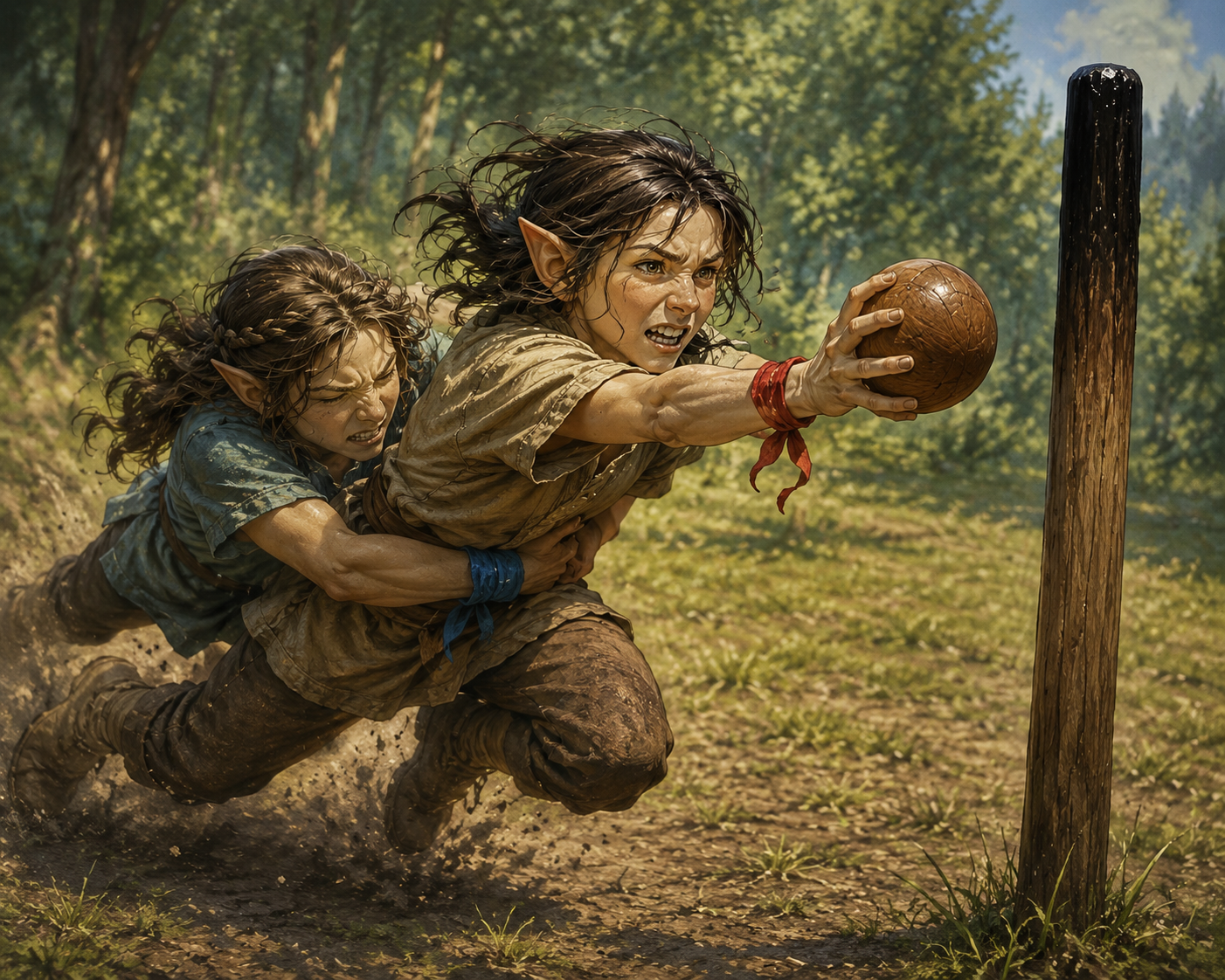
Three scoring posts, known collectively as the Majantu, stand in each offensive end. One stands at the center of the back line, while the other two are positioned approximately ten yards to either side along the arc of the field. Each Majantu stands about five feet tall. A point is scored only when a player in full control of the Soj physically touches one of the Majantu. Throwing the ball at a Majantu never counts as a score.
Play follows a rhythm unlike most human games. Whenever defenders gain possession, they may not immediately attack. Instead, they must make an unobstructed pass to their team's center player. The center player then turns and passes the Soj to one of the offensive players, who begins the attack. Every change of possession follows the same sequence: Defense → Center → Offense.
Offensive players may carry or pass the Soj, but before an attempt may be made on a Majantu, the Soj must have been possessed by at least two different offensive players during that attack. This prevents a single exceptional athlete from dominating the game and encourages cooperation and awareness.
Defenders attempt to ground the ball carrier rather than overpower them. When a player carrying the Soj is legally grounded, possession immediately transfers to the opposing team's center player, beginning the transition from defense to offense once again. Players may use body positioning, legal tags, and grounding techniques, but deliberate contact with another player's head is strictly forbidden.
The first team to score five points wins the match.
Although Soj is played for enjoyment, elves regard it as an important teacher. Every field is different, every match presents new tactical problems, and victory usually belongs not to the fastest or strongest player, but to the team that best understands spacing, timing, and opportunity. The game rewards awareness above all else.
One of the oldest sayings in elven culture comes directly from Soj:
"Don't chase the Soj. Watch the Majantu."
Originally spoken by experienced players to eager children who focused only on the moving ball, the phrase has become a common proverb throughout elven society. It reminds elves not to become so focused on immediate events that they lose sight of what truly matters. It may be spoken by parents, teachers, military commanders, rulers, or members of the Taan'a'lorn Sisterhood whenever someone becomes distracted by the obvious while overlooking the true objective.